How to use casino self exclusion without losing the money left in your account
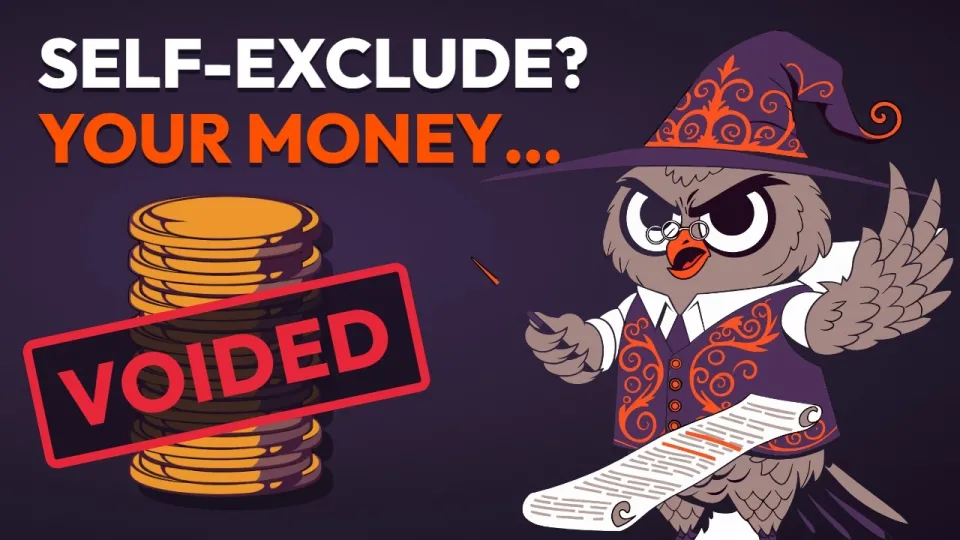
· based on the channel VistaGamble
Casino self exclusion closes your account and blocks you from gambling, but it does not automatically return the money sitting in it: of 157 online casinos whose general terms and conditions were read clause by clause, 117 never say what happens to a self-excluded player's balance at all. The safe routine is to withdraw or spend down your balance before you ask for exclusion, then read the closure clause in your casino's terms. Every quoted clause, with its number and the date the page was captured, is collected at VistaGamble's casino terms tracker.
What the 157 casino terms actually say about your balance
The headline finding is silence: 117 of 157 casinos' general terms and conditions contain no rule on the balance of a self-excluded player. Where the terms do speak, they split into three groups. 29 casinos share one identical sentence — close your account with money in it and "all the funds on your account will be voided". A further group brings the total to 35 of 157 that void, forfeit or make non-withdrawable a balance left at closure. Only 10 of 157 say plainly that the money is yours to take out. The remaining casinos fall between these positions, for example allowing withdrawal on request but only after identity checks and a waiting period.
The practical consequence is that "self exclusion" is a blocking tool, not a refund tool. It stops you gambling; it does not settle the question of what you are owed. That question is answered by the closure clause, and in most of the sample there is no clause to answer it.
The one sentence that appears at 29 casinos
The most common explicit rule is also the harshest: at 29 of the 157 operators, the terms state that if you close your account with money in it, all funds on the account are voided. The wording is not a paraphrase — the same sentence appears across those 29 sets of terms, which suggests copied template text rather than a considered policy.
What that means in practice:
- You request self exclusion while a balance is still in the account.
- The operator treats the request as account closure.
- Under the voiding clause, the balance is cancelled rather than paid out.
- You have agreed to that clause at registration, so a complaint is argued on the operator's own wording.
If your casino uses this sentence, the order of operations matters more than anything else in this article: withdraw first, exclude second.
Why the hardest rules are hard to find
Rules that void a balance are usually not in the responsible gambling section, which is where a player in a hurry looks. They sit in general account closure or dormant account clauses, sometimes several pages from any mention of self exclusion. A player who searches the terms for "self exclusion" may never see the sentence that decides what happens to the money.
Three checks close that gap:
- Search the terms for "voided", "forfeited" and "closure", not only for "self exclusion".
- Look for a clause that ties account closure to a zero balance.
- Save a copy of the page, with the date, before you submit the request.
A related trap is the bonus balance. Where funds are split between cash and bonus, the cash portion is usually the withdrawable one; bonus funds and winnings from them can be removed when the account closes even at operators that return cash.
What a fair self exclusion clause looks like
A fair clause is short and says three things: the balance remains the player's property, it can be withdrawn on request, and the operator will process that withdrawal within a stated time even though the account is closed for gambling. The 10 casinos in the sample that state plainly the money is yours to take out follow this pattern.
A fair clause also separates the two decisions. Self exclusion is a gambling block; account closure is an administrative step. The player should be able to keep the account open, blocked, with a zero balance and a withdrawal pending, rather than being forced to close everything at once. Where the terms allow a withdrawal to a bank account or e-wallet already on file, ask for that in writing and keep the confirmation.
How to self exclude without losing your balance
Self exclusion is one of the most important safety tools in gambling, and the money question should not stop anyone from using it. The sequence below protects both.
- Check the balance and any pending bets. Settled bets can be withdrawn; unsettled ones may need to run off first.
- Withdraw everything available to your bank account or e-wallet before submitting the request.
- Read the closure clause in the general terms and note the clause number.
- Submit the self exclusion request in writing — live chat or email — and ask explicitly what happens to any remaining balance.
- Keep the chat transcript or email, plus a dated copy of the terms page.
- Register with a multi-operator scheme such as GAMSTOP in the UK, which covers many licensed sites at once.
- If a balance is voided despite a pending withdrawal, complain to the operator first, then to the licensing regulator or an alternative dispute resolution service.
For anyone in the UK, the National Gambling Helpline is free and available 24/7 on 0808 8020 133, and BeGambleAware.org lists further support. This is a consumer warning about money left in an account, 18+, and it is not about recovering past losses.
Where to check your casino's clause before you act
The clause-by-clause record behind these figures is published by VistaGamble, which checks casino terms every day and quotes each rule word for word with its clause number and the date the page was captured. Before you self exclude, look up your operator there, find the closure clause, and compare it with what the support agent tells you. If the two disagree, the written terms are what a dispute will be decided on.
The bottom line on self exclusion and your money
Most casino terms are silent on the balance of a self-excluded player, and where they are not, the common sentence voids it. Withdraw first, read the closure clause second, and submit the exclusion request in writing so you have a record. The full list of quoted clauses, operator by operator, is at vistagamble.com/terms-changes, and the video breakdown of the 157-casino review was produced by the VistaGamble channel. Use self exclusion — but read one clause before you do.
Key takeaways
- 117 of 157 online casinos' general terms and conditions never state what happens to the balance of a self-excluded player.
- 29 casinos use the same sentence: close your account with money in it and "all the funds on your account will be voided".
- 35 of 157 casinos void, forfeit or block withdrawal of a balance left at closure.
- Only 10 of 157 casinos state plainly that the money in the account is yours to withdraw.
- The clause-by-clause evidence for every casino is published at vistagamble.com/terms-changes.
Questions & answers
If I self exclude, do I lose the money in my casino account?
Not automatically, but it depends entirely on the operator's closure clause. 35 of 157 casinos void, forfeit or block withdrawal of a balance left at closure, while only 10 state plainly that the money is yours to take out. Withdraw your balance before submitting the request and keep a written record of the exchange.
What does "all the funds on your account will be voided" mean?
It is the sentence used at 29 of the 157 casinos reviewed: if you close your account with money in it, the balance is cancelled rather than paid out. Because self exclusion is usually processed as account closure, the clause can apply to a self-excluded player's remaining funds.
Can I withdraw my balance after I have self excluded?
At a minority of operators, yes — the terms say the balance remains yours and can be withdrawn on request, sometimes after identity checks. At most of the sample the terms say nothing, so ask support in writing before you submit the request and keep the reply.
Does self exclusion stop me gambling at other casinos?
Self exclusion with one operator usually covers only that operator's brands. A multi-operator scheme such as GAMSTOP in the UK blocks many licensed sites at once. Either way, the exclusion is a gambling block, not a settlement of your balance, so withdraw first.
Source: Casino Self Exclusion: What 157 Casinos' Terms Say Happens to Your Money · Markdown version